
Now Reading: Not in My Name: Diaspora Figures Challenge the Armenian Government and Launch Opposition Campaign. By Klaus Lange Hazarian
-
01
Not in My Name: Diaspora Figures Challenge the Armenian Government and Launch Opposition Campaign. By Klaus Lange Hazarian

Not in My Name: Diaspora Figures Challenge the Armenian Government and Launch Opposition Campaign. By Klaus Lange Hazarian

🇦🇲🔥 The diaspora enters the scene. Leaders linked to AGBU and ARF criticize the Armenian government for its stance toward the Church. They speak of a historic rupture. And they do so in the name of the Armenian diaspora.
This week, a group of diaspora leaders—spearheaded by figures linked to the Armenian Revolutionary Federation (ARF) and the Armenian General Benevolent Union (AGBU)—formally aligned to launch a broad critique of the Republic of Armenia’s government. This move comes as the government grapples with Church interference in political life and seeks to counter the opposition’s agenda ahead of the upcoming elections.
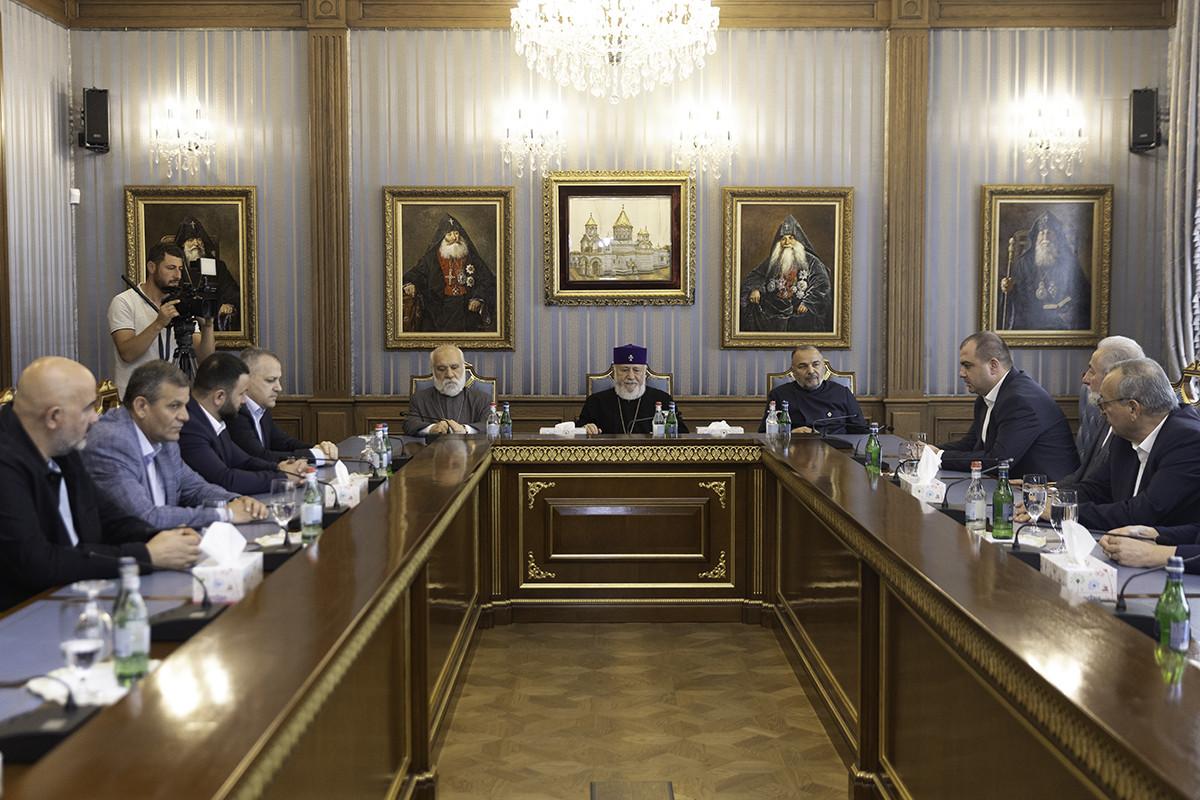
In their statement, the signatories unequivocally assert that matters of Church governance, including the leadership of the Catholicos, must be resolved exclusively within the Church without state intervention. They warn that the government will be held responsible for “deepening” the divisions between Armenia and the global diaspora.
Their warning goes even further: “Whether intentional or not, the Armenian government’s approach risks severing its ties with the diaspora—something that not even the Ottoman Empire or the Soviet Union were able to do.”
The statement was released just a day after the nomination of Samvel Karapetyan, a Russian Deputy Prime Minister and millionaire. He is being portrayed as a victim imprisoned for “defending” the Church, a narrative that omits the fact that his legal appeals were directed against the democratic order.
The letter—identifying its authors as “descendants of survivors of the Armenian Genocide and members of the Armenian World Church”—was signed by prominent figures including Noubar Afeyan, co-founder of Moderna; Anthony Barsamian, former president of the Armenian Assembly of America; Lord Ara Darzi of Denham, the Armenian-British surgeon and member of the UK House of Lords; UCLA physician and philanthropist Eric Esrailian; businessman Vatche Manoukian; French financier Joseph Oughourlian; and Berge Setrakian, former president of the AGBU.
While this statement offers a deeply emotional and culturally rooted view of the relationship between the Armenian Apostolic Church, the State, and the diaspora, a critical analysis in defense of a secular, sovereign, and law-based state suggests their position is misguided. Inadvertently, it takes an authoritarian lean by supporting the hybrid attacks currently being directed at Armenia.
The First Fallacy: The Historical Equation
The central argument—that the current government risks “severing ties” in a way “not even the Ottoman Empire or the Soviet Union were capable of”—is historically untenable and rhetorically manipulative. Equating the policies of a democratically elected government with a genocide that sought physical extermination, or with an atheist dictatorship that sought to eradicate religion through martyrdom, is a hyperbole that trivializes real historical suffering.
The Armenian government is not massacring or exiling the diaspora; it is exercising sovereignty over institutions within its territory. While the diaspora has every right to maintain cultural and religious ties, the Republic of Armenia has an obligation to legislate and administer justice within its borders without its legitimacy being compared to genocidal regimes.
The Second Fallacy: Confusing National Identity with Ecclesiastical Institutions
To claim that a critique of the ecclesiastical hierarchy is an attack on the nation itself is a dangerous conflation. While the Church was a vital pillar of identity during centuries of statelessness, Armenia is now a sovereign republic, not a theocracy. The separation of church and state is a fundamental tenet of its democracy.
The Armenian Constitution guarantees religious freedom and the separation of powers. The fact that most Armenians belong to the Church does not grant the institution immunity from scrutiny. The declaration treats “church self-governance” as if it were above civil law, distorting the line between autonomy and impunity. If members of the clergy commit civil offenses—such as bribery, tax evasion, or incitement to hatred—the State has the duty to judge them regardless of their rank. The legal processing of high-ranking clergy is not necessarily “persecution,” but the standard application of civil law.
The Third Fallacy: Diaspora Pressure vs. National Sovereignty
The signatories threaten to seek “political remedies and legal action” from their respective governments (the US, UK, etc.) to “protect their religious rights,” effectively placing their adopted citizenships above their Armenian heritage.
This reveals a paternalistic and potentially destabilizing view: the idea that the diaspora—which does not reside in Armenia or pay taxes there—has the right to dictate internal policy through foreign pressure. Invoking foreign powers to intervene in Armenia’s domestic legal disputes undermines the state’s sovereignty. It is paradoxical that, to protect an institution that survived genocide, the signatories are using the same tool (external pressure) historically used to dominate and divide smaller nations. Furthermore, the “right to practice religion” in their home countries is entirely unaffected by the legal status of the hierarchy in Yerevan.
The Fourth Fallacy: The Idealization of the Church as Apolitical
Presenting the Church solely as a provider of “spiritual sustenance” detached from politics is a naive, or perhaps deliberately biased, view. In recent years, the Armenian Church has been a major political actor, even making public calls for the overthrow of the current government.
The Church is not a “state within a state” with diplomatic immunity. It owns property, influences voters, and takes public stances against state policy. When an institution with such influence endorses or denounces political movements, it functions as a political counterweight. If the Church wishes to maintain its moral authority, it must adhere to the same rules of transparency and legality as any other institution. Demanding “non-interference” while actively campaigning against the government is an unsustainable position.
A church altar should not be confused with a flag
This statement appeals to emotion and historical memory to defend the status quo of a powerful institution. However, the arguments conflate personal faith with partisan politics. The Armenian government has the responsibility to ensure that all institutions—including the Church—operate within the framework of the law.
If the diaspora truly seeks Armenia’s prosperity, it should advocate for the strengthening of democratic institutions and the rule of law. Severing ties or invoking foreign intervention whenever internal political preferences clash with sovereign decisions is counterproductive. Faith is eternal and personal; politics is earthly and must be subject to legal scrutiny.
We must never forget December 24, 1933, when Archbishop Ghevond Durian was assassinated during Mass in New York. The American press called it “an unprecedented crime.” That tragedy reflected a deep fracture within the diaspora, where both sides claimed the mantle of patriotism while accusing the other of treason. Durian paid with his life for refusing to conflate the altar with the flag.